Review: ConferenceCallTranscripts.org

I have a confession to make, I'm terrible at routinely following up with companies I'm invested in.  I'll give my left brained readers a few seconds to wipe up the coffee they spewed on their keyboard.  I know, I know, I can't be a great investor if I'm not routinely following every last detail and following up on every fact.  The truth is that's not my personality, I'm a more fly by the seat of my pants type.  One one hand I'm more of a creative thinker, yet on the other hand I'm not overly methodical.  I have a funky system for keeping up with companies I own.  I will log into my portfolio at some interval, the interval is random and varies, and will look at some company and think "I wonder what Installux has done recently…"  Then I'll go dig up their filings and read a quarter or two worth of information at once.

Some companies I own are really easy to follow, they publish an annual report once a year, and I get it in the mail.  I always remember to read paper copies of things, but I have a hard time searching for a digital copy of a filing.  If all my holdings mailed their filings and important news to me I'd be set, I'd probably never log into my brokerage, content to read my monthly statements and mailed news.

What's even tougher (for me at least) to keep track of is quarterly conference calls.  Most of the holdings I have don't hold calls, but I do own a few companies that hold calls.  Beyond that there are a few companies that I don't own, but I like to know what they're up to, and it's much easier to read a transcript rather than listen to 45m of "great quarter guys".

The problem is there's no central repository for conference call transcripts.  Some transcripts appear on Yahoo! Finance, but others don't.  At times it's possible to dig through Seeking Alpha and find what I need, but other times I'll get lost reading a flamewar and forget why I visited Seeking Alpha in the first place.

Thankfully Saj Karsan of BarelKarsan.com has come up with a really cool solution.  He wrote a site called Conferencecalltranscripts.org.  The site goes out and visits a number of sites and indexes conference call transcript locations.  He then stores that information and lets users search for transcripts. The site also allows users to create an account and get notified when one of the companies they're interested in has a conference call.

The notification feature is great, I'm signed up and following five companies with notifications.  When things are mailed (physical) or emailed to me I take action.  It's much easier to be prompted to take action rather than remember to take action at some certain interval.

Signing up is FREE, and anyone can use the site without a username or password.  Even if you're just looking for a single transcript it's much easier to look at Conferencecalltranscripts.org rather than bounce between three or four sites.


Thinking like a bond investor

"It would be a sounder procedure to start with minimum standards of safety, which all bonds must be required to meet in order to be eligible for further consideration.  Issues failing to meet these minimum requirements should be automatically disqualified as straight investments, regardless of high yield, attractive prospects, or other grounds for partiality.  Having thus delimited the field of eligible investments, the buyer may then apply such further selective processes as he deems appropriate.  He may desire elements of safety far beyond the accepted minima, in which case he must ordinarily make some sacrifice of yield.  He may also indulge his preferences as to the nature of the business and the character of the management.  But, essentially, bond selection should consist of working upward from definite minimum standards rather than working downward in haphazard fashion from some ideal but unacceptable level of maximum security." - Benjamin Graham, Security Analysis 1951.

I have been thinking a lot recently about stocks as bonds, and looking at a stock the same way a bond buyer would.  For whatever reason the investment world is divided into stock investors and bond investors.  The division seems strange to me because both parties are investing in securities issued by the same companies.  Bond investors are usually worried about principal protection, and yield secondarily.  Equity investors are worried about what yield they can obtain for a security, and sometimes concerned about potential for losses, if at all.

I number of investors have stated to me that they don't know where to look for stocks.  With 60,000 stocks worldwide it's no surprise.  It's much easier to start with a narrow focus and work outwards from there.  In the quote at the top of this post Graham talks about finding a minimum set of acceptable parameters for an investment and using those as a starting point.  A lot of readers believe I only own net-nets.  I write about a lot of net-nets, but my portfolio has a nice mix of stocks, not all net-nets, not even a majority.  My minimum standard of acceptability is a net-net, followed by a low P/B stock, low P/E, EV/EBIT stock, and finally a franchise company.

For me finding a franchise company selling cheap, without serious issues, is the holy grail of investing. All I need to do (theoretically) is buy, and in 15 years I'll have 4x or 5x my money as the business compounds my investment year after year.  A lot of investors start by looking for these franchise companies and then when they don't find any start to move down the chain of potential investments.  Eventually they might end up slumming it and buying a company trading for less than book value, or (gasp) less than NCAV.

The valuation of a franchise company might rest on dozens of variables.  If any one of the variables is misjudged it's possible that the investment thesis could be thrown off, or the result isn't one an investor initially expected.  The opposite is true for a net-net.  There is really only one variable for a net-net, is the company going out of business?  If a net-net isn't facing a situation where they'll cease to exist soon then their valuation is unreasonable.  No going concern should be worth less than their current assets minus all liabilities.

The math starts to get more complicated as one travels upwards from the minimum criteria for investment.  "Is this business worth book value?", "Are earning sustainable?", "What happens if the management team leaves?", "Am I projecting a reasonable growth rate?"

At the beginning of this post I mentioned that I'd been thinking about stocks as fixed income investments.  Part of that thinking relates to making sure my principle is safe when I invest in a given stock.  Buying a net-net is similar to buying a bond below par.  If I buy a bond at $.65 (par $1) and the company is only able to pay $.85 I still have a gain on my investment.  When looking at a deeply discounted bond I am concerned about the collateral, what's the quality of it, can the company use it to borrow against, or sell for a reasonable value?  I'm worried about the seniority of my investment as well.  If I'm behind a number of other claims it doesn't matter that I'm buying at $.65, I might only get $.45 back after everyone else is paid.  But most importantly I'm worried about interest coverage.

Bond investors are content as long as their interest is covered by operating earnings.  If the company is able to generate sufficient operating earnings in a period of distress they will receive interest due to them.  If the bond is backed by high quality collateral and has seniority then interest coverage rules the day.

As equity investors I don't think we spend enough time looking at coverage ratios.  If a company has debt I know most investors make sure the interest is adequately covered, but beyond that there isn't much research.  I've been toying with the idea recently of stress testing net-nets and companies I'm interested in.  What I mean is not only looking at how many times the company can cover their debt with operating earnings, but how many times a company can cover operating expenses, and how much of a revenue drop is necessary before the company falls into the red.

I recently profiled Mexican Restaurants, and one of the reasons I haven't invested yet is because I'm worried about this stress test.  Mexican Restaurants has their lease expense covered 3x by sales minus labor/sg&a/cogs.  The company has lease expenses of $5m in 2012, and only $800k in the bank.  If sales dropped off 25% they would have trouble paying for their locations, this is a major concern.  At the opposite end of the spectrum a cash-box I own, Goodheart-Willcox could last almost two years with zero revenue before they would have problems paying employees and printing textbooks.  The company has almost two years of cost of goods sold and SG&A expenses in the bank.

An extreme case of this is some Japanese net-nets which could operate for a number of years without ever selling an item.  The more applicable example would be looking at how far sales need to fall before the company starts to lose money and has trouble paying their bills.  After determining this value the next step is to look in the recent or even the distant past and see if sales have ever dropped by that amount.  If they have a moment of deep introspection will be required.  If sales dropped by 35% in the past, and 32% pushes the company into the red, what does that mean for an investor?  How long can the company survive losing money?

My goal is to not lose money when I invest.  I fail at achieving this goal, but I can work hard to minimize it.  I think looking at worst case scenarios, and viewing stocks as bonds can help mitigate a loss situation.  Any company is vulnerable to a random exogenous event, but losing money in a situation that was predictable ahead of time is unacceptable.

I recently walked through this method with a long time holding of mine.  I realized that the the upside was limited due to the fact the company already had a monopoly in many markets.  Yet the downside was potentially large because regulators had suddenly taken an interest in the company, and wanted the company to pay for the monopolistic "sins".  I ended up selling off a large portion of my position, the risk was asymmetric on the downside.

As investors we need to be mindful of our principle, always watching and ensuring we don't lose principle.  If we buy enough equities or bonds below par the returns will work themselves out.

Talk to Nate

Big announcement

I am happy to announce an outgrowth of Oddball Stocks, Unlistedstocks.net!  This has been a project I've been working on for greater than six months, and it's finally ready for the general investing public.

Many of the stocks that I profile on this blog are not exchanged traded.  That means they trade on the pink sheets, or the over the counter market.  Prices are set by quotes obtained from brokers.  Some unlisted stocks report financials to the SEC or OTC Markets.  Other unlisted companies are completely dark, essentially private companies with a portion of the float available for investable by the public.

Up to now obtaining information on the darkest companies was a tough task.  An investor had to place an order and wait sometimes months before getting a fill.  Then they had to call the CFO and ask for a copy of the latest financials.  The process is tiresome and tedious, especially if the company isn't worth a further investment.

Unlistedstocks.net solves this problem. The site is an online database of unlisted stocks.  The database allows users to view updated financial information about unlisted companies.  In addition users can screen the database for specific criteria they might be interested in.  Users are encouraged to comment on companies as well adding additional information such as blog posts, new articles, or general insights.

I wrote the entire site myself, it was born out of an idea I had for a community of unlisted stock investors back in April.  I am not a coding guru so I favored simplicity where possible.  The result is a very fast and clean site with just the information you need.

How to join?

There are two ways to join.  The first is to sign up as a user, pricing for users can be found here.  This option is appropriate for most investors.

The second way to join is as a contributor.  A contributor is someone who might already invest in this space, and in exchange for financial information on a company not yet in the database the user receives a discount on their subscription price.  Keeping the contributor rate is easy, just upload an updated annual report for the company you initially submitted and your discount will remain intact year to year.

One final note for contributors, no bank stocks will be accepted to the database.  I have a second project focusing specifically on bank stocks, Unlistedstocks.net is non-bank stocks only.

In celebration of the Unlistedstocks.net launch I'm offering a coupon for the next week (expires 12/10/12) to readers of Oddball Stocks.  When you signup for Unlistedstocks.net use the coupon "oddballstocks" for 10% off.

Why join?

Some of the companies in the database are expensive with share prices in the hundreds to thousands of dollars per share.  You could end up spending $1,000 for a share to learn the company isn't worth an investment.  Do this often enough and you'll have thousands of dollars invested just to get information.

Instead of spending thousands of dollars to get this information you could get it for just a few hundred dollars on Unlistedstocks.net.  To buy one share of every stock in the database would currently cost $8,649.26, that's a lot of money just to find out if these stocks are worth buying.  You would have to subscribe to Unlistedstocks.net for 29 years before it would be cheaper to do this on your own.

I would be surprised if you didn't make your subscription back from an investment in some of the companies in the database.  Incidentally there's a company I didn't put in the database because as I was researching them for entry I noticed they were being taken private.  The company is going private for $4.05 a share and shares trade between $2 and $3, this is an inefficient area of the market for sure!

If you want to purchase this through your company and need an invoice please email me.  The price is low enough you could probably just sneak it through your expense account.

Join here

Screenshots:

Here is a typical detail page for a given company:

If you like a company you're looking at you can always add them to a watchlist.  The watchlist page is a great place to keep notes and thoughts while researching a given company.


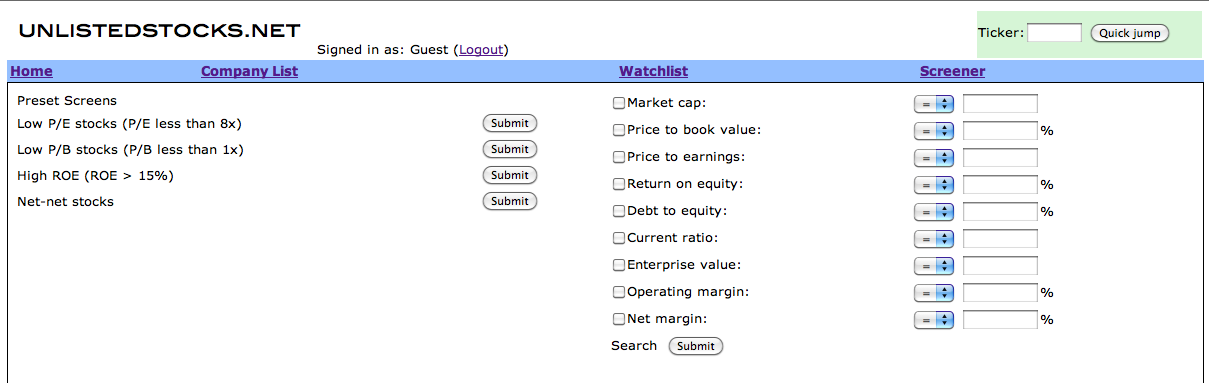
If going through the database one by one isn't your style you can run a pre-set screen, or generate your own custom screen with specified criteria.


All of the information for each company is exportable to Excel using the following icon:


Here is the Excel spreadsheet generated for Goodheart Wilcox:


Looking for more information beyond what's in this post?  Have a question you want answered directly, email me about Unlistedstocks.net.


Cheaper than a burrito, Mexican Restaurants

I enjoy meaningless metrics for some reason.  I remember in 2008 hearing a commentator on TV say that Citi's shares cost less than an overdraft fee.  In the case of Mexican Restaurants (CASA) you could either buy a combo platter at one of their restaurants, or 8-10 shares of their stock.  Mexican food is known for being inexpensive, and like the food Mexican Restaurants is inexpensive as well.

Mexican Restaurants falls into one of my favorite investing categories, a company that is mis-priced on so many different levels it's almost unbelievable that the opportunity exists.  Let me lay out exactly how cheap Mexican Restaurants is; the cost to franchise one of Mexican Restaurant brands is between $814,000 and $2,504,000 per store.  As an individual you could either invest $2.5m to start a franchised location, or buy all of 52 of Mexican Restaurant's stores for $3.7m.

The company is a restaurant operator in the American Southwest, they own 52 locations, have 13 franchisees and one licensed location.  The company has had a rocky few years with a trail of losses extending from 2008 until very recently.  As the company accumulated losses over the past few years they cut underperforming stores and rationalized their workforce.  They continued to lose money until this year when operations turned around and their cost cutting paid off.  As part of the cost cutting measures the company delisted.  If anyone is still wondering why they're cheap, they have a history of losses, they're tiny, and they're unlisted.

There's not much about Mexican Restaurant's stock to not like.  They are trading at 35% of book value, and at 5x their net income from the first 9 months of this year.  After a $2m debt payment this quarter book value will increase to around $4 per share.  The company will also be debt free at the end of the year.

Here are the company's results for the past three years:


Valuing the two pillars, asset and earnings

Assets - Valuing the company on an asset basis is the easiest and most stable.  Earnings can change from quarter to quarter and year to year, asset values are much stabler.

The company's most recent book value was $11.285m, this is against a market cap of $3.6m.  Most of the company's assets consist of restaurant locations and associated equipment.  The company leases their locations, it's unclear if they own the buildings or just the equipment inside the buildings.  Without this information it's really hard to know the exact value of their property plant and equipment.

It's hard to know the exact value, but we're not out of luck, on the Casa Ole (one of their brands) website there is a little tab with information about franchising a location.  The website states that it takes an investment of between $814,000 and $2,504,000 open a single location.  Based on that information I built the following table:


We don't know the breakdown of costs per location so I created three scenarios: pessimistic, moderate and optimistic.  I just did some basic extrapolation to get a total number.  The number you're looking at is what it would cost in theory for the company to re-create themselves at the current investment level they demand of a franchisee.  The first thing you'll notice is that these values greatly exceed the market cap, by a factor of 10x to 36x.  

It would be foolish to stop here and state that Mexican Restaurants is worth anywhere between $42m and $130m on a replacement cost basis.  No one is replacing the company, or trying to build them from scratch.  Their equipment is used, and has probably lost a lot of value.  Even with a lot of the value lost there is still value left.  If we take my grid above and estimate that a current location is worth 10% of the buildout cost the value of the assets drop to a range of $4m to $13m.  The book value of the locations is $12.3m, which after working through the gymnastics above seems to be reasonable.

I wanted to work through all of this to show that even though book value is an accounting construct it does roughly reflect a real world value.  Some readers might question my 90% discount as overly cautious, but I'll ask a rhetorical question to answer why I used that value.  A set of new chairs and a table for a restaurant cost $300 based on prices online.  If a local Mexican restaurant was going out of business and was selling their tables and chairs how much would you willingly pay for the used set?  For $30 I could probably convince my wife to put them in a man cave, anything more and they wouldn't be coming home with me.

Earnings - Initially it would seem tough to value the company based on earnings coming out of a recent turnaround.  The company has been losing money for the past four years, so maybe the recent earnings are a fluke.  If one looks further back into their history it's clear they know how to make a profit, here's a clip from their 2009 annual report:

Note that they earned $.63 a share in 2005, $.32 in 2006, and $.10 in 2007.  The number of shares in the above graphic are similar to the current number, so the EPS figures are relevant.  If the company can get anywhere near past earnings this is an incredibly cheap stock.

Over the past nine months the company has earned $722k against a market cap of $3.6m.  If the company just breaks even the next quarter they're trading at an effective P/E of 5x.  My suspicion is that now that costs have been contained they're going to do better than break-even next quarter.  It's not hard to see where if earnings do recover how this company could be a double or triple at a minimum.

Of course no company is perfect, and it's always possible to find something to not like about an investment.  In Mexican Restaurants' case there are a few things I could nit-pick on, the first is they have a convoluted capital structure.  The company has convertible preferred stock, common stock, and warrants.  A company with multiple securities in the capital structure isn't necessarily bad, but it's a sign that they had to resort to expensive equity raising measures in the past.  The company has some cash in the bank, but not nearly enough to weather another extended downturn.  If results were to head south of the border again they might have to raise money through equity or preferred offerings again.

A second nit-picky item is the company reports in their latest annual report that $167k of their cash was restricted.  It was ear-marked for community relation purposes at employee discretion.  In theory this could be anything from someone wearing a burrito suit standing on a corner with a sign advertising to a charitable donation, or a local restaurant sponsoring a baseball team.  Without further detail it's hard to know exactly, but the result is clear, $167k of the cash should be removed from the balance sheet.

Lastly even though the company is escaping the burdens of debt they do still lease a number of their properties.  They don't break out ownership vs lease, but my impression is a large number of the locations are leased.

The risk with Mexican Restaurants is that they'll hit with another prolonged downturn and their lease expenses become a burden.  If they don't hit another bump in the road it's hard to see how this stock doesn't appreciate significantly.

If you're looking for even more reading on the company my friend at OTC Adventures wrote them up here.

Talk to Nate about Mexican Restaurants

Disclosure: No position

The problem with linear thinking

Congratulations for actually reading this post, most people saw the title and clicked away thinking "I don't do that, it's not for me."  This post isn't breaking any new ground.  Maybe a few will learn something new, and while it's important to keep learning, it's also important to continue to refresh existing knowledge.  This is a refresher post.

Linear thinking is a shortcut for completely thinking through a problem.  It's easier to look at quarterly earnings of $.25 and multiply by 4 rather than estimate what they might actually be due to seasonal fluctuations.  Linear thinking and estimations are everywhere, a casual read of the news or research papers would leave one with the impression that we live in a linear world.  The problem is we don't, often trends reverse, or change due to some inflection point.  I think people like linear trends because it makes them feel like they can guess what the future might look like.  No one knows the future no matter how hard we try to predict it.

My favorite example of linear thinking is personnel assignment for projects.  If a project is estimated to take one person 80 hours there's this widespread myth that assigning two people will get it done in 40 hours, and four people in 20 hours.  The problem is that doesn't account for overlap, or communication overhead.  At a certain point adding an extra person on the team actually lengthens the time needed to finish a project.  There's a book on this topic dealing specifically with software engineering, but the principles are universal, The Mythical Man Month.

Mythical man months and linear thinking are everywhere in investing.  Just go back to any article from 2006 and you'll see the economy and stocks will follow a nice smooth path upwards forever.  I don't know why people accept this sort of reasoning.  Anyone who's lived for even a little bit knows it's not true.  Growth comes in spurts, a child grows very quickly the slows down with bits of fast growth.  Most businesses are similar, they grow fast for a while then mature.  Even nations grow in spurts, the baby boom in the US was a large spurt, the echo-boom a smaller one.  Between those population booms were years of lower than trend birth rates.  With regards to birth rates linear thinking abounds, every few months a story will appear saying Russians will disappear in 400 years, or the Japanese will cease to exist in 300 years at current rates.  When birth rates are high articles are written discussing when the world will run out of capacity, or strategies to slow down growth.

Very few companies have linear growth, for me this is the downfall of DCF calculations.  How do you model lumpy growth?  Some companies do have this predictability, I worked for one that signed all customers to long term contracts with 5% increases each year.  So for them it would be appropriate to model out 5% growth to eternity.  Or at least growth until technology blows up their market.

Warren Buffett, or his followers talk about only buying companies if you know what they will look like in 10 years.  This is great sound bite material for CNBC, but it's unrealistic.  Did Buffett really know what investment banking would look like in 2018 when he made his Goldman Sachs investment?  I doubt it.  We often look at things in a linear fashion when trying to estimate far into the future, and it can be a downfall.  The problem with a linear thought is it blinds us to uncertainty and potentially negative consequences.  The strong moat of Eastman Kodak in 2000 was worthless in 2010, but how many predicted digital cameras would be in cell phones in every pocket back in 2000?  I know I sure didn't.  I remember seeing my first digital camera in 1993, it could fit 100 pictures on a 3.5in floppy disk.  That means each picture was around 14k, the camera was huge and bulky, it was a hobby thing.  Serious photographers used film cameras.  Now about 20 years later I have a camera in my iPhone that's probably 100x or 1000x better than that bulky digital camera and at 1/10th of the cost or less, not to mention the size difference.

Some companies that look strong in the moment fall quickly to technological, or cultural shifts.  MySpace was the king of social networking a few years back.  Who would have thought they'd be complete irrelevant now?  I own a franchise company (Mastercard) and I think about this often.  They have a strong network, but very quickly a competitor could emerge and turn the industry on its side destroying Mastercard's moat.  My concern is that I'll spot this too late after my investment is impaired.

A parting thought before moving on is that the average lifespan of a company has shrunk from 67 years in 1920 to 15 years in 2012.  So when someone says to think 10 or 15 years out that means thinking about the successor or bankruptcy of the company you're examining, a sobering thought.

When I considered doing this post my first intention was to bring awareness to thinking that could be harmful to our investments.  The second goal was to show how this could be exploited.

I find that investors have a very strange fondness for linear thinking thar's often not found outside of investing.  When two sport teams play each other a non-committed bystander usually roots for the underdog.  A very common plot for American movies is an underdog achieving greatness against all odds.  Yet when it comes to an underdog company the standard expectation is it will just decline into oblivion in a straight line.  Conversely great companies like Apple or Starbucks will just grow to the sky forever with investors enjoying sunny days and endless dividends.

When presented with a tight situation people are able to dig down and find resolve to face a tough situation.  Ideas and strength not found in everyday life present themselves and can come to the rescue.  Not every desperate situation works out well, but enough do solely on human perseverance that others in dire straits can remain hopeful.  Investing in cigar butt companies can be similar to a down and out individual.  Not much needs to go right for things to change.  If the negative trend merely stops that can sometimes be enough.

Linear thinkers believe that all net-nets go to zero, why else would a company trade for less than NCAV?  Of course the evidence says otherwise.  Linear thinking says that big giant companies with steady growth will continue to grow forever, a quick look at the Dow over the past 100 years says otherwise.  Beware of linear thinking, and take advantage of it when the opportunity presents itself.

Talk to Nate

Bogen a spinoff with uncertain motivations

Unlisted companies are famously opaque, so it's no surprise when an unlisted company decides to spinoff a division that they're less than forthcoming with information.  The company in question is Bogen Communications International.  Thanks to a Twitter message, and a post from Inelegant Investor   at Stock Spinoffs I was alerted to the strange spinoff occurring at Bogen.

The company recently issued a press release stating they were spinning off a wholly owned subsidiary named Bogen Corporation.  The release is confusing to say the least, the company announced the spin of a subsidiary, except there is almost no mention of this sub in their annual reports.  The company announced the spin on November 20th, which is curious considering the record date for the spinoff was November 19th.  Shareholders will allegedly get to vote on this, but with management owning 70% the vote is nothing more than a token measure.

This transaction caught my attention for two reasons, the first is this is an unlisted stock, and I'm naturally attracted to these, and secondly after looking at the annual report is seemed like there might be some opportunity here.  The company barely makes mention of their two divisions except for a small section at the bottom of the notes in the annual report.

The company is an audio products company, they design, and manufacturer speakers, amplifiers, and sound systems.  The products all appear to have professional applications, from stadium speakers, to rack mountable mixing boards.  The company also sells products for intercoms and school broadcast systems.  Further evidence that the company targets a professional customer is the fact that the only way to purchase products is through a sales rep, or a very limited set of distributors.

In the US spinoffs are known to be an area of the market where outsized returns can be found.  I find it fascinating that spinoffs have generally only been profitable when American companies are doing the spinoff. I remember seeing some literature (don't remember where) a year or two ago that looked at global spinoffs and for the most part the stocks of the spun off companies resulted in a small loss.  My impression is that American companies spin off a division to unlock value; they provide incentives to management at the new spun off company to do well.  Non-American companies spinning off divisions do it to dump an underperforming division.

The motivation behind the Bogen spinoff is very unclear, but looking at the segment information from the past few annual reports we can get a glimpse of what management is thinking.


The above are the results for the Bogen Corporation division for the past six years.  The company's US operations have been profitable every year except for 2009.  The foreign operations haven't been profitably any of the past six years.

The company has a respectable gross margin and operating margin.  I didn't calculate the net margin because my net income figures are estimated.  The company carries a small amount of debt, and I'm not sure which division the debt belongs to, or how the interest costs might break down.

Maybe the company's international operations will turn around, it's possible, but I wouldn't want to speculate on it.  Instead I think the opportunity here lies in the domestic operations.  The company states that 58% of the total assets belong to the domestic operations.  The domestic subsidiary generates 100% of the profits.  Spinoffs are usually conducted on an asset basis not an earnings basis.  If we applied that formula to Bogen the domestic operations would have a market cap of $10.44m against a net income of $2.8m for a P/E of 3.73x.  Clearly the better investment is the Bogen Corp spinoff, and I think management realizes this.

Why would the company management suddenly decide to spin off the profitable operation?  Management owns 70% of the outstanding shares, and they can effectively do what they want with the company.  My guess is they are looking to sell one of the divisions and a potential acquirer said they would be interested but they only wanted to buy a portion of the company.  It was easier to spin off the undesired division rather than complete a purchase for a portion of the company.

After looking into Bogen the question I had was how do I buy the spun off shares?  I don't have an answer, I'm not sure if the Bogen Corp shares will even trade publicly after the spinoff.  If the Bogen Corporation shares do eventually trade I think they offer a very compelling opportunity, with an extremely low valuation, and a management that might be motivated to sell.  If anyone has more information regarding this spinoff I'd appreciate an email, or a comment.

Talk to Nate about Bogen

Disclosure: No position

A profitable cash box, or a cash box with profits?

A common feature of most net-nets is a pile of assets with a tiny obsolete business attached.  While his isn't always the case, is the exception not the rule to find a good profitable business selling so cheaply.  Metalink (MTLK) was suggested to me by a reader (thank you!), they're a foreign issuer, a cash box, and a net-net, the siren call was strong, how could I not look at them?

There's a certain market cap threshold where even I get a little queasy.  I don't have a problem investing in a company with a $6m market cap, yet once the market cap drops below $3m I start to get nervous.  I get nervous because my pool of potential buyers shrinks.  I know that by investing in the microcap space I'm already limiting myself to retail investors, and small funds, but below a certain market cap I'm limiting myself to other individuals as crazy as myself.  Metalink falls below my psychological threshold of $3m, although only slightly.

Metalink might be the first investment that literally checks off every potential box for a net-net.  Profitable: yes, mostly cash: yes, obsolete business: yes, no debt: yes, no liabilities: yes, no leases: yes, no future direction: yes, and on and on.

The company is a DSL chipset manufacturer.  For anyone born after 1988 DSL is a technology that ushered the US onto the information superhighway.  DSL technology was an enormous improvement in internet connection speed.  Allow me to take a quick walk back in time.  I remember my first modem, it was 2400 baud, I had a friend with a 4800 baud of whom I was jealous.  I'm guessing a few readers are thinking "wow, 2400 baud, he's young" and the rest are clicking to Facebook while the thought "what's a baud" is forgotten.  Technology quickly went from 300 baud, to 1200, to 2400, to 4800, then 9600.  From there we jumped to 14.4, and finally 28.8 and theoretically 56.6.  When the dot-com bubble was booming most people were connecting to the internet at 28.8k or 56k speeds.  In about 10 years connection speeds had increased 10x.  This is the reason the internet boomed, we always had those networks (BBS anyone?) but they were so slow that anything more than colored text was unusable.  Telecom companies were looking to maximize connection speeds using existing technology, which were copper wires and DSL fit the bill.  When a human talks on the phone voice only utilizes a portion of the frequencies that the wire can carry, DSL sought to fill this extra space with data.  Customers used to have to install DSL splitters to block out the data frequencies on their land lines.

DSL technology seems so quant today where we can connect at speeds of 10 Mbps or 25 Mbps on a standard internet package.  But keep in mind the jump, a standard DSL connection was 768kbps verses the fastest model a 56k which at most could do about 43kbps.  Going from a fast modem to a DSL connection was almost a 20x increase in speed.  A similar jump was possible with cable, but not all neighborhoods were wired for cable, whereas anyone with a phone in theory could have DSL as long as there was a DSLAM installed at the local switchboard.  The limit to DSL was the drop distance, that is the distance from the DSLAM to the end point.  The longer the distance the slower the speed of the connection.  Warren Buffett claims all knowledge is cumulative, I never thought the things I learned about DSL 15 years ago would be relevant today, yet here we are...

Metalink comes into the picture in the sense that they coordinate manufacturing and distribution of DSL chipsets.  For years they were involved in the research and development of new chips, but as DSL has moved from the front to the back of the broadband line they eliminated all R&D.  The company has whittled themselves down to simply a distributor of their old DSL chipsets.  They outsource fabrication to third party chip fabs and sell to a few remaining customers.  The company end of lifed their chips back in 2008.

The company doesn't have much going for them in terms of a future outlook, they aren't developing any new products, and plan to continue selling existing products until clients don't need them anymore.  The business has stabilized and the current run rate should be expected into the future until demand ceases.  With a more normalized cost structure they've moved from losses to making a profit.

Let me summarize the high level discussion before diving into the details of this investment.  Metalink sells an outdated obsolete chip technology that's currently profitable with an uncertain outlook.

The starting point for analyzing Metalink is the balance sheet, here is their balance sheet summarized in my net-net template:


The company has an excellent balance sheet with $1.89 in NCAV, a discounted NCAV of $1.82 and a net cash position of $1.67.  It's worth mentioning that shares are trading at $1.04.  In other words, this is a profitable net-net selling for less than net cash outside of Japan.  Their location (Israel) isn't without risk, which I'll discuss below.

I want to call out a few things from the balance sheet, the first is the company doesn't have much inventory.  This is because chips are manufactured as customers demand them, and are shipped straight from the fabrication location.  The chips that have been manufactured but haven't been received by the customer are what's been captured on the balance sheet.

The second item I want to call out is the lack of liabilities.  The company has some accounts payable, that's it, no other liabilities.  I don't think I've ever seen a company with so few liabilities.

Metalink's record of profits has been much worse than their working capital management.  They were consistently unprofitable until they sold off a loss making division a few years ago.  Since then they've only had the DSL chip business that doesn't generate much revenue, but it's enough to cover fixed expenses with a tiny bit left over.  While the company is profitable the statement I'd make is caution needs to be taken when considering their future.  The business is unsustainable and it's possible sales could dry up, I don't know if that's in six months, or three or nine years, regardless of the timing it will happen eventually.

A discussion of Metalink wouldn't be complete without a discussion of management and their plans for the pile of cash.  Management owns 40% of the outstanding shares, which isn't a majority, but enough to push the company in any direction they want.  In the 20-F statement the company mentions they would like to use their cash for something strategic, possibly an acquisition.  This is where things get a little crazy in my mind.

The company only has one employee at this point, the CEO.  He's essentially arranging the fabrication, then the shipment of the completed chips to the destination location.  He's also in charge of filing the SEC statements, and whatever else a middleman does.  The company has $5m in cash and is looking to do something with it.  The problem is that while $5m is a lot of money in normal people terms, it isn't all that much in business terms.  I'm not sure what sort of company besides a smaller local one could be purchased for $5m or less.  And I can't imagine purchasing a company and trying to get up to speed and taking control with only one employee either.

Due to the logistical problem, and the low absolute level of cash I don't see an acquisition in the company's future, more likely is a tender, or a buyback to completely go private.

I'd be remiss if I didn't point out the biggest risk to this investment, which is Metalink's location.  The company is located in Tel-Aviv, which as of late isn't the safest place in the world.  The job the CEO is doing appears to be done from home, and in theory could be done anywhere in the world.  He's a plane ride away from moving the business to London or New York.

The second biggest risk is the uncertain future outlook.  We don't know if Metalink will be churning out DSL chips for the next three months, or the next three years.  We also don't know what the CEO will decide to do as his next move, will he tender for the outstanding shares, or will he go out and buy whatever he can for $5m?  If you can reconcile those two risks and are comfortable with them I don't think there's any problem purchasing shares of Metalink.

Talk to Nate about Metalink

Disclosure: None